
The Noisy Mind
A Mental Health Discussion

Before I begin, I want to be clear that I am not a doctor, and this should not be taken as medical advice. I am also not a priest, but a fallible deacon of the Church, speaking from personal experience, Scripture, and the teachings of our fathers. If I make any error, that fault belongs to me and not to the Church or to modern medicine.
It has been a little over two months now since I was officially diagnosed with ADHD and anxiety and started taking medication. Looking back, it is something I showed signs of early in life, but because of the lack of conversation around mental health in our cultural background, it was often treated as something shameful or, in some cases, even as something “of the devil.” We have demonized conversations about mental health, even though mental health is a very broad term, and these conversations need to happen more honestly and more often. So let’s talk about it.
I can only speak from my own diagnosis and personal experience, specifically as someone with ADHD, but I will try to keep the discussion broad enough to speak about anxiousness and mental struggle in general, both of which are very much present in Scripture. When people hear “ADHD,” they usually think of restlessness, being skittish, or being hyper. Although that can be part of it, it is only one aspect of ADHD. A lot of people also make the mistake of self-diagnosing because they equate being energetic or hyper with having ADHD, but that is far from the full reality of how destructive and disruptive ADHD can be. So, what is ADHD? According to the National Institute of Mental Health’s publication Attention-Deficit/Hyperactivity Disorder: What You Need to Know, ADHD is a developmental disorder marked by persistent symptoms of inattention, hyperactivity, and impulsivity, and these symptoms can interfere with daily life, including relationships, school, work, and ordinary responsibilities.
But I want to dive deep into it and separate some things from the world’s shallow understanding of it. For many people, ADHD is not just something that does not allow them to sit still, but the inability to consistently direct the mind, organize the will, control impulses, complete tasks, and even remain mentally present. So this is not just some internet label people use when they get distracted once in a while. These things really interfere with daily life. One of the most difficult parts of it is that it can make ordinary life feel harder than it should be. Simple tasks like waking up on time, brushing your teeth, cleaning your room, answering a message, remembering an appointment, or finishing something you already started can become a struggle. People are quick to label this as laziness or say that someone does not care, but the difficult part is that many of us do care, and that is the frustrating part. You know what needs to be done, you understand how important it is, you recognize these patterns in your life, and yet you cannot find the ability to fix the problem. Some people can start but struggle with consistency. When we look at what the National Institute of Mental Health says regarding this, it says:
Signs of inattention can include frequent difficulty with:
“Concentrating on tasks or activities, for instance, while having conversations, taking tests, completing assignments, or reading papers
Listening when spoken to directly
Following instructions or finishing tasks at school, work, or home
Organizing tasks and activities, managing time, and meeting deadlines
Getting easily distracted by unrelated thoughts or stimuli”— National Institute of Mental Health, Attention-Deficit/Hyperactivity Disorder: What You Need to Know
But there are some bright sides to ADHD, although the mind struggles with consistency. ADHD is known to allow people to become very creative. Pattern recognition is also something that can be very useful in day-to-day life, allowing us to notice patterns that people don’t see. Even though it may seem counterintuitive, you can become focused on things you love, which can eventually become what we discussed earlier: it can turn into a hyperfixation, and you start overanalyzing. But the takeaway is that this can range from replaying conversations after they happen and practicing them before they happen, to recognizing your problems but struggling to get out of the trap of your own mind in order to complete the solution
Knowing these things, let us now talk about the effects they have on our spiritual life, especially if you are familiar with the sacramental life. It requires you to be very present, because our church is not a hangout spot or merely a weekly Sunday attendance where you drink tea and eat bread. All those things are part of it, but we are meant to unite with Christ by participating — the key word here being participating — in the things the Church has to offer: constant worship, prayer, repentance, confession, fasting, Holy Communion, and the daily discipline of turning the heart toward God.
The Coptic Catechism describes this perfectly. It describes worship as the lifting of the heart toward heaven, knowing oneself before God, guarding internal and external purity, living in thanksgiving and praise, praying from the conscience, and offering worship with both body and soul. To add to that, these things live outside the Church sanctuary. Things like praying before eating, praying before sleeping and waking up, following a fasting pattern, and living a prayerful life all require constant participation. As Fr. Tadros puts it in the Coptic Catechism:
“It is fitting for us as believers to benefit from the experience of our fathers through the stages of catechism over the centuries, that we may live with a spiritual, living, Biblical mindset in every aspect of our lives; whether in our study of the Holy Bible, our practice of the truly evangelical life, or in our daily conduct; even our eating and drinking, our worship in the spirit of truth, and our service for every person we meet, even if we do not know them personally, and in our conversations with believers and nonbelievers.”
— Fr. Tadros Y. Malaty, Catechism of the Coptic Orthodox Church, Vol. 1, p. 23
And for those who suffer with ADHD or anxiety, because this affects attention, consistency, speech, impulse control, emotional regulation, memory, and follow-through, these things will affect the spiritual life. It will enter the way a person prays, repents, confesses, fasts, listens, serves, and fights repeated sin. This point needs to stay as the foundation of what we are discussing a spiritual life requires attention. Being able to remain vigilant is very important to the life of a Christian and it is the reason why Christ’s repeated command to watchfulness matters. If you recall before the parable of the talents, Christ gives the parable of the wise and foolish virgins, and He ends it by saying:
“Watch therefore, for you know neither the day nor the hour in which the Son of Man is coming.”
— Matthew 25:13
This attention Christ speaks of is not narrow. It is not simply remembering to pray, but living that prayerful life. This is where the need for calmness and an eased mind becomes important. But before I go into what I read from Pope Shenouda, I want to discuss the issue of immigrant communities dismissing conversations surrounding mental health. Many of us grew up accustomed to the idea that conversations related to anxiety, depression, ADHD, therapy, medication, and similar struggles were things to hide from. Parents did not do this because they were cruel. That is not at all what I am saying. Rather, it was often because they were afraid. They came from a culture where family honor, fear of scandal, distrust of outsiders, and spiritual language were fused together. The result is that young people often end up carrying things above their load alone.
The Church herself has no fault in this. In fact, this gives a much deeper meaning to when the priest washes his hands and proclaims:
“As I have cleansed my hands from outward pollution, so also I am pure from the blood of you all. If you presumptuously draw nigh to the Body and Blood of Christ, I will not be responsible for your reception thereof. I am pure of your wickedness, but your sin will return upon your head if you do not draw nigh in purity.”
— The Divine Liturgy
The Church, which is one with Christ and is represented through the priestly ministry, is not responsible for this wickedness because the teachings of Scripture and Christ directly contradict the environment formed by external factors. As a matter of fact, this environment goes against everything we know as Christians. Our Lord and Savior Jesus Christ bore flesh to participate with us. I am not saying that Christ had anxiety as a disorder, nor am I trying to diagnose Him. Rather, I am saying that in His true humanity, while remaining sinless, He truly experienced the realities of human life: hunger, exhaustion, tears, suffering, grief, and anguish.
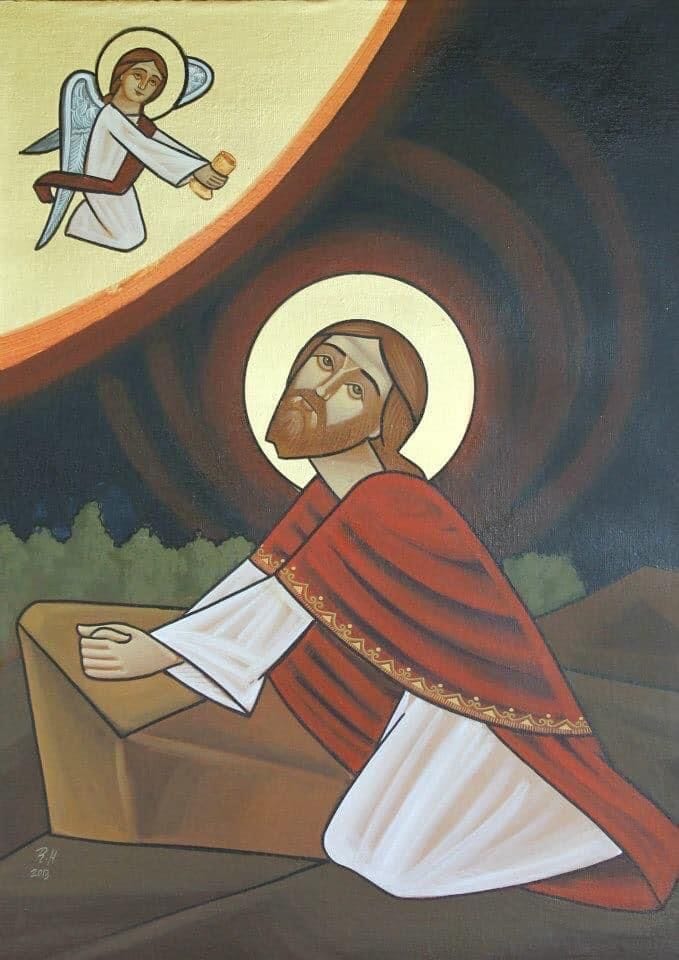
We see this clearly in the Garden of Gethsemane. The Gospel of Matthew records that Christ “began to be sorrowful and deeply distressed,” so much so that He told His disciples, “My soul is exceedingly sorrowful, even to death” (Matthew 26:37–38). He communicated His distress to His followers, and what did they end up doing? They fell asleep, much like many of our people have when those around them suffer silently. In the Gospel of Luke, we also see Christ in agony, praying more earnestly: “And being in agony, He prayed more earnestly. Then His sweat became like great drops of blood falling down to the ground” (Luke 22:44). Christ did not enter the world from a distance or love His creation from arm’s length. He entered into our condition in true love. He participated with us.
Another thing that must be addressed is that spiritual strength does not mean suffering is absent. We see this through the lives of many saints in the Church. St. Paul, who, according to tradition, was martyred, endured bodily weakness and suffering. Other saints endured grief, persecution, isolation, illness, and more. For the record, again, I do not have the credentials to diagnose anyone, nor is that what I am doing. I am trying to make the point clear: spiritual greatness does not mean you are immune to physical or mental ailments. You are not proven spiritual by being woundless. Rather, strength is shown by bringing your wounds to the One who heals, and by refusing to let those wounds become despair, whether healing comes through Christ directly, through the life of the Church, or through an earthly physician.
The Catechism also strengthens this point:
“If illness weighs us down, let us not be sorrowful as though, because of the illness and the prostration of our bodies we could not sing, for all these things are for our good, for the purification of our desires. Truly fasting and sleeping on the ground are set before us because of our sensuality. If illness then weakens this sensuality the reason for these practices is superfluous. For this is the great asceticism: to control oneself in illness and to sing hymns of thanksgiving to God.”
— Amma Syncletica, quoted in Fr. Tadros Y. Malaty, Catechism of the Coptic Orthodox Church, Vol. 2, p. 19
According to the Catechism, the person should worship as he is able. This also includes those who suffer mentally. The point is not that suffering removes the spiritual life, but that the spiritual life must meet the suffering person truthfully. A person who is weighed down by illness is not outside the reach of worship. He may worship differently, with weakness, with limitation, and with struggle, but he is still called to bring himself before God as he is.
So if illness does not remove us from engaging in a liturgical and sacramental lifestyle, who is to say that we cannot seek proper care? Seeking treatment should not be seen as a betrayal of faith. Scripture has shown many times that God bestows authority, ability, skill, and responsibility upon people here on earth. When we look at the disciples before they were called, many of them had ordinary professions. Matthew, although his profession was not respected by many of the Jews, was a tax collector. Peter, who was first called Simon, was a fisherman. Andrew, James, and John were also fishermen. Even outside the Twelve, St. Paul worked as a tentmaker, and St. Luke is remembered as a physician. Christ Himself was known as the carpenter’s Son, and He entered into a world where ordinary work, skill, trade, and profession were part of human life.
So doctors are not enemies of God. Medicine is not automatically opposed to faith. The Wisdom of Sirach says plainly:
“Honor a physician with the honor due him, for the uses which you may have of him; for the Lord created him.”
— Sirach 38:1
A few verses later, it continues:
“The Lord created medicines from the earth, and a sensible man will not loathe them.”
— Sirach 38:4
This is not something many of us are accustomed to, especially when it comes to mental health. We were raised, in many cases, to loathe it or to fear it. Seeking help for a broken arm, a cold, or the flu is not treated as a betrayal of God, so why do we treat the mind differently? Is the mind not part of the person? Is it not part of the human life that God created and desires to heal? Sirach gives us a balanced view: healing ultimately comes from God, yet God can work through physicians, medicine, knowledge, and the created order.
Something I noticed while preparing this writing is the way Christ responded when the Pharisees tried to trap Him over paying taxes to Rome. He answered, “Render therefore to Caesar the things that are Caesar’s, and to God the things that are God’s” (Matthew 22:21). Most people hear this verse, and I include myself in that, and immediately think of government authority. They would not be wrong, because that is part of the immediate context. But maybe this is something we can think about more broadly. This could also show us that Christ does not teach us to reject every earthly structure simply because it belongs to this world. He teaches us to live within a lawful human society while still giving God what belongs to Him completely.
But we must remember that we cannot and do not serve two masters, because worship, conscience, ultimate trust, repentance, and obedience belong to God alone. Yet this does not mean that every profession, public office, or field of knowledge is opposed to God. A Christian can receive help from the structures of ordinary life without surrendering his mind, body, and soul to them. The issue is not simply whether a person receives medical or psychological care. Rather, our concern must be whether that care is received in the proper order. As long as God remains the Lord of the person, physicians, therapists, counselors, and other professionals can serve as instruments of care within the created world. For me, the desire for treatment was connected to my desire for calmness. I did not want medication as an escape from living a sacramental life. I wanted help for the part of me that struggled to be still enough to practice the spiritual life with attention. If the mind is constantly noisy, if the will starts and stops, if the conscience sees patterns but execution collapses, then treatment can become one part of pursuing order. It is not the whole answer. It is not the end of the struggle. But it can help create the conditions in which prayer, confession, repentance, and ordinary obedience are approached with more stability. That is where Pope Shenouda’s book Calmness became important to me, because, specifically for me, as someone diagnosed with ADHD and anxiety, this book, which was recommended to me, was a beautiful guide that helped me through this new journey and experience. So let's begin by trying to understand what calmness is. Pope Shenouda speaks about calmness as something that touches the whole person: our temperament, nerves, body senses, thoughts, heart, speech, and behavior. Being that ADHD and anxiety affect all these things, that is why this book really grabbed my attention (the irony), but let's begin with a quote from the book :
"Calmness is composed of various elements: calmness of temperament, tranquillity of the nerves, and stillness of the body, which includes the serenity of the senses, movements, and features. There is also inner calmness, the peacefulness of the soul, which is made up of the tranquillity of the heart and thoughts. From this also comes calmness of speech and behaviour."
— Pope Shenouda III, Calmness, p. 38
So here, Pope Shenouda makes something very important clear. The spiritual life is not something separate from the whole human person. If the nerves are restless, then the tongue may also become restless. If the thoughts are restless, then the heart may also become restless. And if the heart is constantly interrupted, it may become unstable, figuratively speaking. So how can someone keep a prayerful life if the heart is not in tune with the mind? If the heart is constantly viewing everything through fear, repentance can mutate into despair, preventing the person from returning to God.
This is why, early in the book, Pope Shenouda writes:
“In calmness, a person can think in a balanced way. With calmness, he can solve his problems, with no agitation or confusion of thoughts.”
— Pope Shenouda III, Calmness, p. 26
Pope Shenouda, in the quote above, does not water down calmness into some sort of productivity measurement, as if calmness is only valuable because it makes a person more efficient. Rather, calmness is about truly gathering yourself before God. This is why the shame that our parents’ generation was taught to feel is so dangerous. Shame tells a person to hide the struggle because it makes him defective. The opposite error tells a person to name the struggle, so he never has to repent. Neither one is the correct path for a Christian. The Christian path is confession without despair, pursuing treatment without abandoning the Church, and recognizing the importance of a balanced spiritual life. It is prayer without pretending that medicine has no value, and medicine without pretending that grace is unnecessary. Being Christian means having the humility to recognize the struggle truthfully, to take responsibility for what must be repented of, and to seek help from God, the Church, and lawful care without shame. So the takeaway from all of this is simple, even though there is much more that could be addressed. The practical reason calmness belongs in this discussion is that a noisy mind not only needs to be tended to; it also needs to be trained. The life of a Christian requires structure, guidance, repentance, and patience. Christ asks us to love Him with all our heart, soul, mind, and strength. If we yearn to be brought back to Christ, then we must bring all of ourselves to the One who receives the trembling soul and makes it still.
At the same time, we must remember to offer what we can. Struggle is not a reason to abandon the pursuit of wholeness. Seek proper treatment when it is needed. It can help stabilize the person, but calmness in the Christian sense is deeper than symptom relief. It is the reordering of the whole person before God, so that the body, tongue, thoughts, conscience, will, and heart can return to their proper work. I may do a part two diving into other things that I find interesting, but for now, this should suffice. Once again, I am not a physician or a priest, so my words are only my experience and reflection. Please continue to keep me in your prayers. May we continue to repent, confess, return to Christ, and partake of the Holy Eucharist with preparation, reverence, and guidance. May the intercession of the saints be with us all.
Glory be to God forever and ever. Amen.
Sources used
Fr. Tadros Y. Malaty, Catechism of the Coptic Orthodox Church, Vol. 1, especially p. 23.
Fr. Tadros Y. Malaty, Catechism of the Coptic Orthodox Church, Vol. 2, especially pp. 19 and 458.
Pope Shenouda III, Calmness, especially pp. 26 and 38.
Pope Shenouda III, The Life of Repentance and Purity, especially p. 9.
Sandy Guergues Aziz, Religiosity and Attitudes Toward Psychological Health, Distress, and Help-Seeking Among Coptic Orthodox Parishioners, 2018.
Scripture references: Sirach 38:1–4; Matthew 22:21; Matthew 26:37–38; Luke 22:44; Galatians 6:2; Romans 15:1; Mark 6:3; Mark 12:30; Colossians 4:14.
Really insightful and I believe that it’s a really relevant topic at the moment. Definitely needs to be a matter of discourse in the Ethiopian community and immigrant communities as a whole. I love that you sighted scripture and the fathers to really drive home the point that struggling with mental health and seeking help isn’t veering away from a spiritual life but can act as a supplement to it. Thanks for brining this matter to the spotlight and may God bless your work brother!
Very professional and articulately written! Thank you for writing this article, beloved brother. I loved the comparison you made between our Lord’s sorrow; where He was openly vulnerable to His suffering to which the Apostle’s responded by falling asleep. I never noticed the parallels between this event and that within in our community. Well done, Deacon!